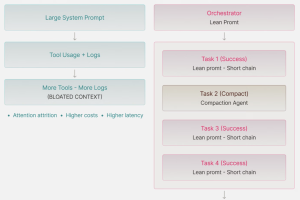
Vibe code is legacy code
Legacy code is universally despised, and for good reason. But why? You have the code, right? Can’t you figure it out from there?
Visual Studio Code has cemented its reputation as one of the most powerful and versatile code editors for developers. While its core features are well-known, there exists a treasure trove of hidden functionality and extensions that can dramatically transform your development workflow.
Picture this: You’re in a meeting room at your tech company, and two people are having what looks like the same conversation about the same design problem. One is talking about whether the team has the right skills to tackle it. The other is diving deep into whether the solution actually solves the user’s problem. Same room, same problem, completely different lenses.
Our success depends on increasing both the number of designers who receive leads and the number of leads each designer receives. Designers will share their work, advertise their services, and transact through the platform only if they expect to land more clients as a result.
Finding and chasing new clients is exhausting. Getting more work out of existing ones is much easier, more rewarding and more lucrative. Here’s how to go about it.
“I continue to think that glasses are basically going to be the ideal form factor for AI, because you can let an AI see what you see throughout the day, hear what you hear, [and] talk to you,” Zuckerberg said during the earnings call. Adding a display to those glasses will then unlock more value, he said, whether that’s a wider, holographic field of view, as with Meta’s next-gen Orion AR…
Google DeepMind has unveiled AlphaEarth Foundations, a breakthrough AI system that creates highly detailed maps of the entire planet. Announced today, the system tackles a key challenge for scientists and governments: how to process the overwhelming flood of daily satellite data.
Microsoft has successfully transformed itself into the AI backbone of the corporate world. New earnings showed it’s all‑in on AI infrastructure
Let’s say we want some stepped gradients like the ones below, with a certain number of steps.
Chrome 139 is experimenting with Open UI’s proposed Interest Invoker API, which would be used to create tooltips, hover menus, hover cards, quick actions, and other types of UIs for showing more information with hover interactions. The Interest Invoker API makes these components declarative and hover-triggered, meaning that you create them with HTML, and then the web browser handles the mouseenter and mouseleave events for you, sans JavaScript.